
S-Theory
S-Theory™ for Social Innovation
Complex social challenges rarely exist in isolation. Issues such as social inclusion, youth disengagement, demographic change, mental health, community participation, or territorial inequalities are interconnected and constantly evolving. Addressing them requires approaches capable of embracing complexity rather than simplifying it. S-Theory™ is a place-based social innovation methodology developed by the SIC CLM to support communities, organisations, and territories in navigating complexity, fostering collaboration and generating sustainable transformation. It combines systems innovation, transformative learning, narrative inquiry, asset-based community development, and developmental evaluation into a coherent framework for collective action and territorial change. At the heart of S-Theory™ lies the belief that meaningful transformation happens when people develop a deeper understanding of their reality, strengthen relationships, mobilise local assets, and create new narratives about what is possible. Rather than offering predefined solutions, S-Theory™ provides a structured yet adaptable process that helps communities learn, imagine, co-create and steward change together.
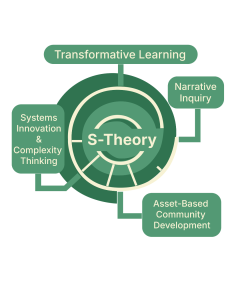
The methodology is represented through the S-Spiral, a dynamic process that guides participants through seven interconnected pathways: Sensing, Patterning, Imagining, Visioning, Creating, Harvesting and Sustaining. These pathways support stakeholders in understanding complex systems, uncovering hidden dynamics, exploring alternative futures, co-designing solutions, learning from change and building long-term collaborative ecosystems. The «S» reflects the core principles underpinning the methodology: Spiral, Systems, Social Imagination, Stories, Sensemaking, and Stewardship, while also recognising its origins within SIC CLM. Together, these dimensions create a framework that is simultaneously systemic, participatory, narrative-driven and future-oriented.
S-Theory™ can be applied in community development, social innovation ecosystems, education, youth work, organisational transformation, public policy and place-based innovation initiatives. It is designed for those seeking not only to solve problems, but to strengthen the collective capacity to learn, adapt, and shape more inclusive futures.